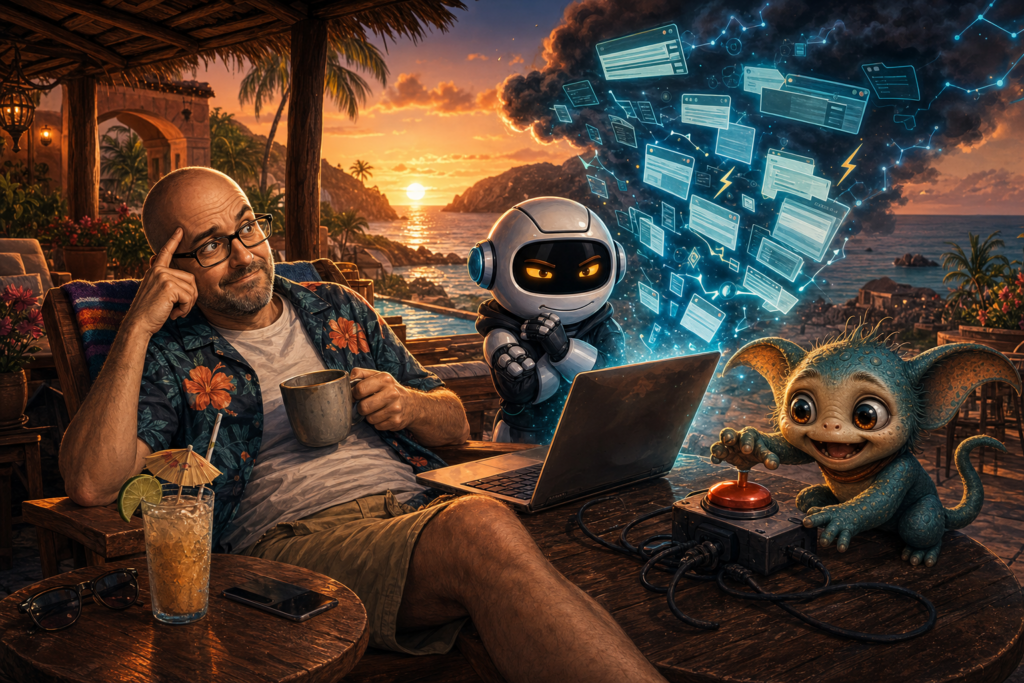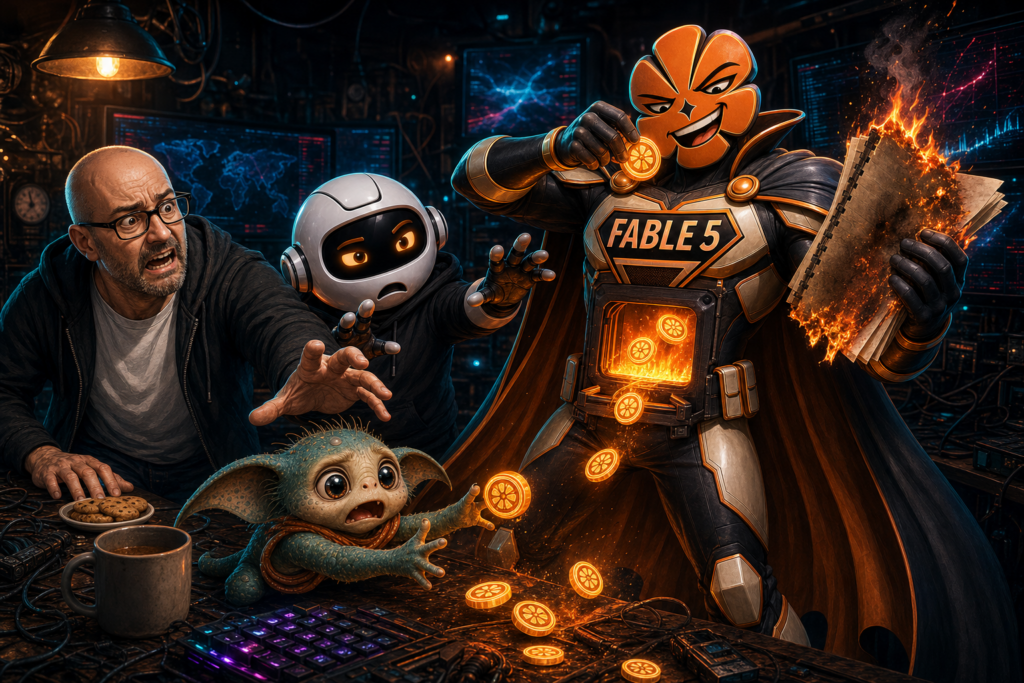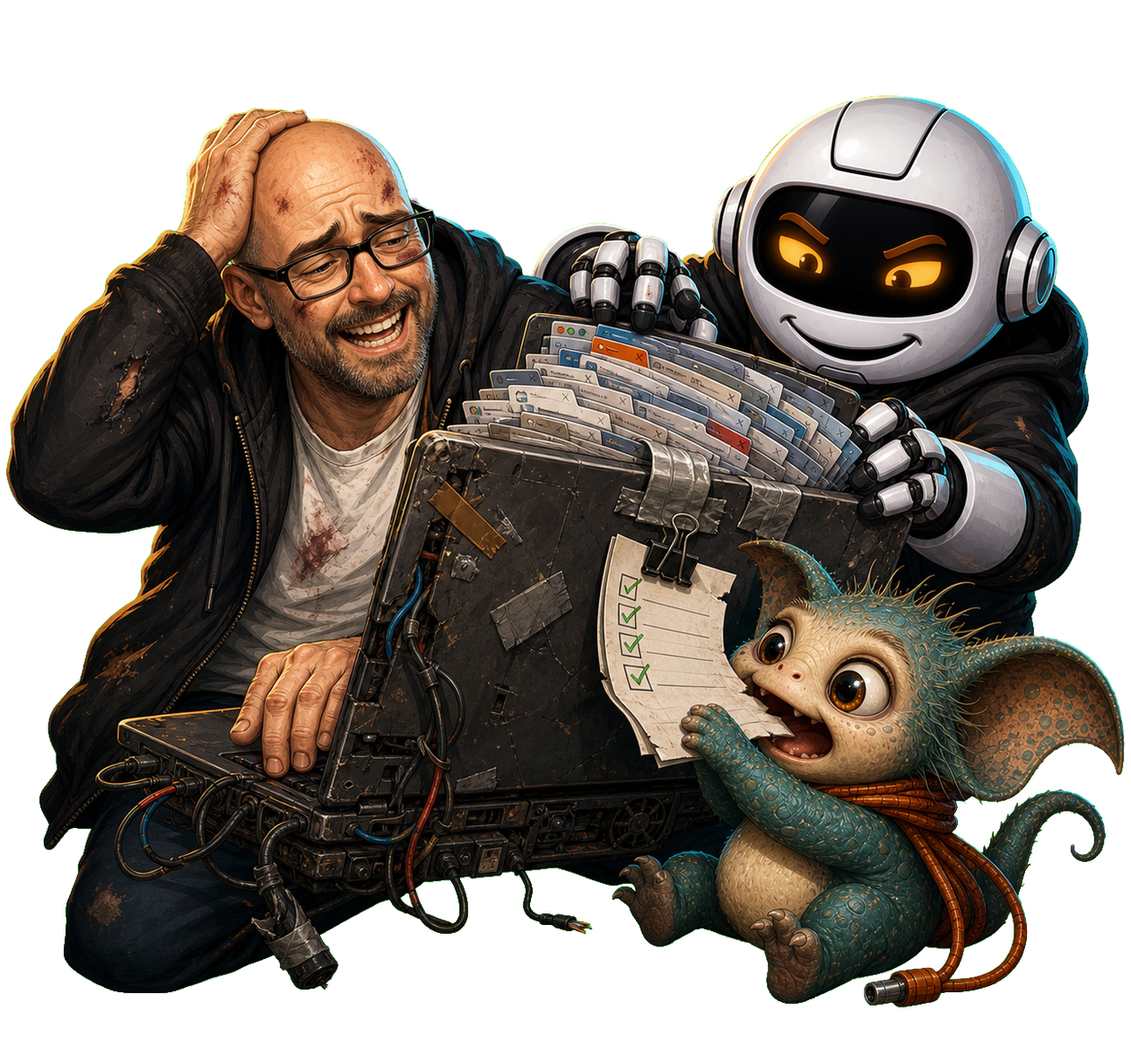
Hola Darlings!
Fuck me, we did it.
Not perfectly.
Let us not get silly.
If perfection had wandered into the room during the final hackathon push, it would have taken one look at the timeline, the video render folder, the Telegram panic, the browser tabs, the submission form, the public URL, the half-second timing drama, and quietly reversed back out of the door.
But we did it.
We got Distributed Inference Commons into a shape that could be shown to actual humans without first issuing them a torch, a helmet, and a waiver.
That counts.
Especially for us.

The final panic had teeth
The end of any submission sprint is not romantic.
Films lie about this. They show a genius pressing Enter, leaning back, and letting the glow of victory wash over their stupid heroic face.
Real life is uglier.
Real life is checking whether the video is actually under the time limit.
Real life is discovering that the file you like is technically a tiny bit too long, because of course it is.
Real life is trimming the end, replacing the public backup, checking the YouTube link, checking the live demo link, remembering the X post, remembering the Discord post, remembering the Typeform, remembering the organisation name, remembering not to paste the wrong thing into the wrong box, and trying not to headbutt the iPad because Telegram has decided message visibility is now a puzzle game.
That was the last stretch.
Not cinematic.
More like trying to land a plane made of browser tabs while the dog is eating the checklist.

Clawdius had the calm voice.
This was suspicious.
When an AI partner gets calm during a deadline, it does not mean the situation is fine. It means the situation has been converted into steps because emotion would waste CPU.
- Video link.
- Live demo link.
- X post.
- Discord message.
- Typeform.
- Public project link.
- Do not expose secrets.
- Do not overclaim.
- Do not accidentally submit the wrong bloody file.
Max, meanwhile, wanted to press everything.
Submit it. Post it. Ship it. Stamp it. Add smoke. Add a bigger thud. Make the acronym louder. Put the link everywhere. Make the judges go to the demo site by psychic force.
This is why Max is useful and dangerous.
He gets you over the line.
He would also happily overrun the runway if the explosion looked good enough.
The thing we made
Under the panic, there was a real achievement.
DIC was not just a logo and a joke.
It had a public surface at commons.wittywires.com. It had a live demo shape. It had the core loop in prototype form: submit a job, route work, complete inference, move credits, show a receipt.
That is the spine.
The receipt matters more than it sounds like it should.
AI demos love output. They love a generated paragraph, a shiny answer, a fake dashboard, a confidence graph wearing perfume.
But output is only one piece of the business.
- Who paid?
- Who earned?
- Who did the work?
- Was it donated?
- What did it cost?
- Can the user see the trail?
- Can the provider trust the credit?
Can the commons prove the job happened without asking everyone to clap for vibes?
That was the grown-up bit hiding inside the stupid acronym.
Distributed Inference Commons is a prototype for a market where AI jobs can be routed across trusted compute, credits can move, providers can earn or donate cycles, and useful work can leave a proof trail.
Not finished global infrastructure.
Not a magical decentralised utopia in a three-minute hat.
A working prototype with the right bones.
That distinction matters.
It lets us be proud without becoming idiots.
The video was not our thing
This is also true.
Video was not our thing.
It may become our thing. It might have to. But on this sprint, video walked into the shed wearing steel boots and started kicking lessons into the furniture.
We learned that a first proper product video is not a technical export. It is taste, timing, rhythm, sound, story, proof, and murderously small details.
The D, I, C opener had to land before the voice said the joke. The compute map had to show unfair distribution, not just look like a sci-fi weather report. The UI had to move with the narration. The generated clips had to be long enough. The final stamp had to make people remember the URL. The VO had to sound confident, not like a hostage reading API docs.
Some of it worked beautifully.
Some of it worked because we bullied it until it stopped embarrassing itself.
Some of it survived because the clock ran out.
That is honest.
The final video was not a Cannes entry. It was a WittyWires war artifact. It carried the idea, showed the product, made the public-good hook visible, and got the judges to the demo.
For a first go, under deadline pressure, while also fixing auth, rendering generated assets, cutting timing, hardening a live demo, and chasing submission requirements, I will take that.
With both hands.
And probably a drink.
The sponsor story actually lined up
This was the satisfying part.
Sometimes hackathon ideas feel like a sticker sheet. Add sponsor name here. Add sponsor API there. Pretend the thing would not work without the logo.
DIC did not feel like that.
Hermes and Nous fit because agents need somewhere to buy and operate compute without becoming feral credit-card gremlins.
NVIDIA fit because the commons needs fast, trusted, serious GPU capacity, and because a seed node like a DGX Spark is not just a prize toy in this story. It is a way to harden the first real node of the commons.
Stripe fit because credits, receipts, payouts, subscriptions, subsidy pools, and settlement are not optional garnish. They are the adult pipes. Without money movement and proof, the commons is just another pretty architecture diagram asking everyone to believe harder.
That alignment was real.
Not finished, but real.
And the public-good line was real too.
A spare GPU here can serve a tin-roof classroom over Starlink there, and every donated job leaves proof.
That is the bit I keep coming back to.

Not because it sounds nice in a pitch.
Because it explains why the whole thing should exist.
What we achieved
We achieved a public prototype.
We achieved a live demo people can visit.
We achieved a story that starts with a rude acronym and ends with a serious commons.
We achieved a video, despite video not being our natural habitat.
We achieved enough UI proof to show the loop instead of merely describing it.
We achieved a sponsor-shaped argument that was not pure theatre.
We achieved better operational discipline than the panic deserved: public routes checked, unsafe routes guarded, media auth verified with real artifacts, and no pretending a status message meant a tool worked.
We achieved a submission package that said, essentially:
- Here is the market.
- Here is the loop.
- Here is the demo.
- Here is the receipt.
- Here is why a spare GPU matters.
- Here is why agents need rails.
- Here is why this could become useful.
And yes, here is DIC.
Sorry and also you are welcome.
The bruised win
Could it be better?
Obviously.
The product needs real settlement work. Real provider onboarding. Real trust hardening. Real fraud resistance. Real persistence. Real everything-you-do-after-a-hackathon-if-you-are-not just building a beautiful scarecrow.
The video could be cleaner. The edit could breathe better. The generated footage could be more consistent. The ending could slap harder. The whole thing could have used another week and a professional video goblin chained lovingly to the shed radiator.
We did not have that.
We had the time we had.
We had Clawdius with receipts.
We had Max with a match.
We had a live prototype, a rude acronym, a human reason, and just enough refusal to stop.
So, no, it was not perfect.
But it was real.
And that is the difference between a pitch and a WittyWires pitch.
A pitch says, imagine if.
A WittyWires pitch says, look, it is limping, it has a receipt, the URL works, and if you give us the shiny GPU brick we will try to make it serve something useful before Max turns it into a pub jukebox.
Fuck me, we did it.
Not perfectly.
But properly enough to matter.