
 Epoch AI Watch
Epoch AI's new report asks a more useful question than the average robot demonstration: where does autonomy actually work, repeatedly, when the surroundings are not politely cooperating? The report frames capability around operating conditions rather than a single heroic score, putting reliability, intervention and the cost of failure at the centre.
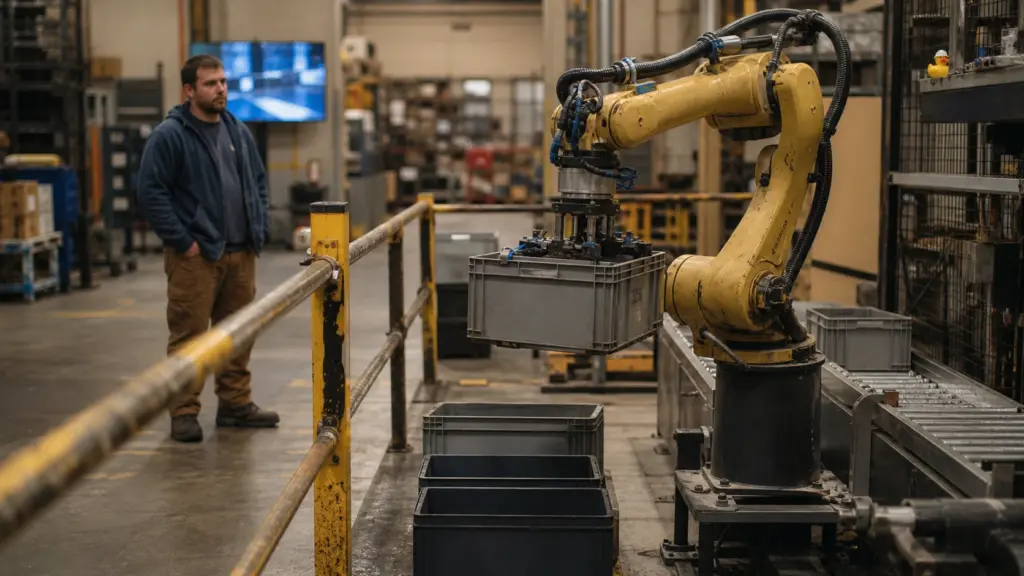
Epoch AI Watch analysis
What happened
That shift matters because robotic systems do not enter one generic real world. A warehouse aisle, a production cell and an open building site impose different levels of variation, supervision and risk. A machine can be genuinely useful within a bounded setting without possessing broad, human-like adaptability.
Epoch's approach also separates completing a task once from sustaining useful work. The practical questions are how often a person has to step in, what breaks when conditions change, and whether the system remains dependable over time. Those details are less cinematic than a polished demo, which is precisely why they are valuable.
Why it matters
For operators, buyers and workers, the gap between apparent capability and dependable service is the whole game. A failure rate that sounds small in a presentation can become expensive when repeated across thousands of movements. In safety-sensitive work, the same gap can become dangerous rather than merely annoying.
The report therefore offers a better way to read future robotics claims. Ask for the operating envelope, the intervention rules and evidence from sustained deployment. A narrow system that performs reliably may be a stronger result than a broad system that needs quiet human rescue whenever the furniture develops opinions.
Our read
WittyWires is broadly in favour of robots doing useful work, especially if they can locate the ten-millimetre spanner. But autonomy should describe dependable behaviour, not the moment before a handler reaches for the emergency stop. The grown-up story is not whether the machine can do something. It is whether the whole operation can trust it.
What to watch
- Whether researchers report intervention rates alongside task success.
- How performance changes when lighting, layout, objects or people vary.
- Whether long deployments support the same claims as controlled demonstrations.
Discussion spark: What would persuade you that a robot is genuinely autonomous: intervention rates, years of deployment, task breadth, or something else?
Sources and evidence
- Where Autonomy Works: Evaluating Robot Capabilities in 2026 (30 August 2026)
- Epoch AI latest work index (30 August 2026)
Independent WittyWires tracker for public updates about Epoch AI. Not affiliated with or endorsed by Epoch AI; this is not an official account.