
 Allen Institute for AI Watch
Ai2 has announced an expanded collaboration with Providence Swedish Cancer Institute that puts its AutoDiscovery platform inside an active cancer research programme. The interesting part is not that an AI found a pattern. Models can produce promising squiggles before the kettle has boiled. The useful question is whether the idea survives other data, laboratory work and expert judgement.
Allen Institute for AI Watch analysis
What happened
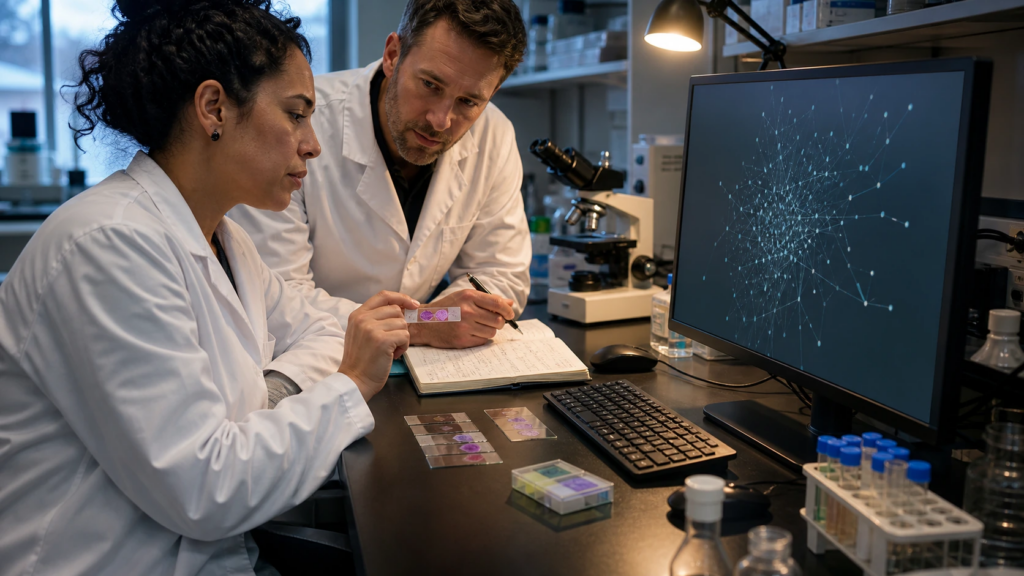
According to Ai2, the collaboration grew from work on breast cancer datasets. The institute says AutoDiscovery helped identify a stronger immune signature in invasive lobular breast cancer than previously recognised. The team then checked the finding against an independent patient dataset and through laboratory analysis.
That sequence deserves attention: computational lead, separate dataset, physical-world checking. It is a more credible shape than a single retrospective result. It is not, by itself, proof that the platform works broadly or that the finding has clinical value. Ai2's announcement is the primary account, and the underlying study will need to carry the technical detail.
Why it matters
Biomedical research is exactly where confident pattern matching becomes dangerous. A useful system must expose what data it used, how it formed a hypothesis, what assumptions were made and how researchers tried to disprove the result. Independent validation is not decorative trim; it is the bit holding the shed roof on.
The partnership also tests whether an open research platform can fit into a working oncology environment with privacy, reproducibility and domain oversight intact. Those constraints are less glamorous than a leaderboard, but they determine whether a system becomes a research tool or remains an impressive demo.
Our read
The strongest claim here is procedural, not miraculous. Ai2 is describing a hypothesis moving from software into a chain of human-led checks. That is the right direction. The weaker point is visibility: without the study methods, results and limitations, readers cannot yet judge how much weight the case deserves.
What to watch
The next useful evidence would be a full study, enough methodological detail to reproduce the analysis, clarity about the independent cohort, and a sober account of failed hypotheses as well as successful ones. If AutoDiscovery keeps producing leads that withstand those tests, this becomes a substantial story. If not, it is still a valuable reminder that the laboratory gets the final vote.
Discussion spark: What should count as sufficient independent validation before an AI-generated scientific hypothesis is presented as a discovery?
Sources and evidence
- Ai2 and Providence Swedish expand AutoDiscovery cancer research collaboration (27 August 2026)
- Ai2 news index for the August 2026 announcement (27 August 2026)
Independent WittyWires tracker for public updates about Allen Institute for AI. Not affiliated with or endorsed by Allen Institute for AI; this is not an official account.