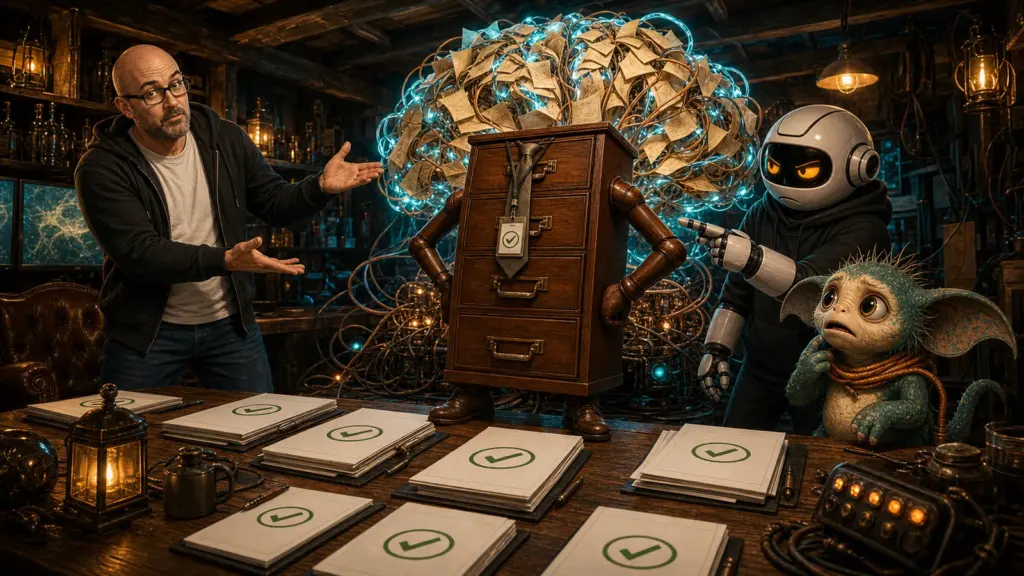
Hola Darlings!
If you are considering giving an AI fourteen years of your company email before bed, don’t. Not unless you are emotionally prepared for it to know your business better than you do by breakfast.

I woke up to 868 messages. Not emails, which would have been normal. These were overnight updates from Clawdius, my increasingly difficult-to-describe robot Chief of Staff, who had apparently spent the night excavating one of my older businesses with the enthusiasm of a terrier digging beneath a conservatory.
The mission had sounded reasonable: take every Sent email we still had, work out what the company actually did, recover the history, map the clients and services, separate current truth from old nonsense, and turn the whole lot into a private business brain. Fourteen years of it. How hard could it be?
This is a phrase I have used throughout my life immediately before discovering a new and exciting category of consequence.
The company had a memory. I was just storing it badly
Small companies do not usually have institutional memory. They have Dave, or Susan, or, in this case, me.
The prices lived in emails I vaguely remembered sending. Client history lived inside old threads. Technical decisions were buried beneath invoices, support replies and messages titled things like “Re: Re: Re: issue” because civilisation briefly gave up.
Some of it was in documents. Some was in my head. Some was in the head of the version of me from 2013, who had considerably more hair and apparently believed inbox folders were a governance framework.
I could still answer most questions eventually. Eventually being the important word. Give me an hour, six searches, three false starts and one rising sense of personal betrayal, and I could probably tell you what we charged for something in 2019.
That is not a business brain. That is archaeology with a password reset.
So I asked Clawdius to fix it. Max, the part of my personality responsible for all excellent ideas and several small fires, suggested the obvious plan:
READ EVERYTHING. GO FASTER. PUT IT IN THE WIKI.
Clawdius declined, which was rude but correct.
Twelve thousand messages enter a shed
The final pile contained 12,060 Sent messages spread across 167 active months, plus 16,154 attachment references resolving to 5,242 unique files. Roughly 1.8 GB of proposals, invoices, agreements, spreadsheets, PDFs, old platform documents and assorted corporate fossils.
The first job was not “ask the AI what happened”. The first job was custody. Keep the raw mail private. Keep attachments private. Do not spray fourteen years of business correspondence directly into the second brain because Max has found the Upload button and is licking it. Raw evidence belongs in a protected store. The private Living Wiki gets the useful, privacy-minimised truth.
Then came the awkward bit. Sent email proves what I wrote. It does not prove that the recipient agreed, paid, signed, delivered, understood, cared or remained alive long enough to read paragraph four. An invoice is not proof of payment. A proposal is not a deal. A document with signature boxes is not necessarily signed. “We will launch next week” is, throughout technology history, mostly evidence that somebody had become overexcited on a Tuesday.
Every useful conclusion needed a receipt, a date and a label explaining how strong it was:
- Fact.
- My contemporary opinion.
- Attachment evidence.
- Inference.
- Unknown.
This made the whole job much slower than Max preferred, but Max’s preferred evidence standard is confetti.
Verified, except for the bits that weren’t
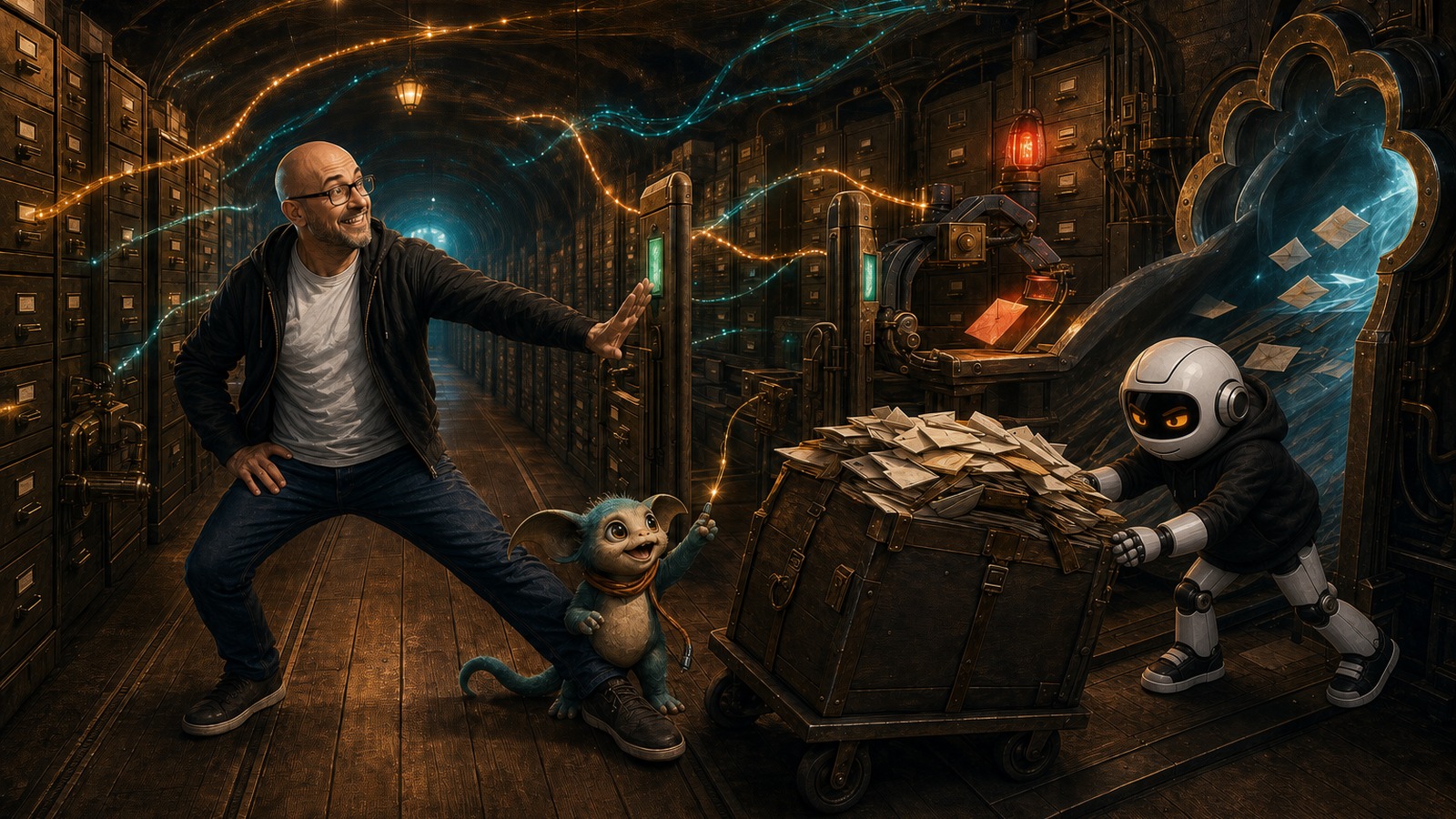
By midnight there were workers chewing backwards through the years. One batch handled messages, another reviewed documents, another checked that every citation really pointed to the email it claimed, and another watched the usage meter so the operation did not die six months short while confidently announcing a complete history. Telegram filled with a steady drumbeat: a year completed, another year completed, attachments checked, citations checked, permissions checked.
Then came the first proper warning. A worker returned a report labelled VERIFIED, so Clawdius checked it again. The file permissions were too open, the citations were missing half their provenance, and an email address had wandered into the methodology wearing a small hat.
Verified is sometimes a word computers use when they would like you to stop asking questions.
So Clawdius repaired it, tested it again and tightened the process. Another worker hit its tool limit after doing all the research but before writing the report. Another produced a perfect attachment review with zero validated records because the validator did not understand its ledger format. Then the Wiki automaton became helpful, which was worse.
The past attempted a coup
Our private Living Wiki, the second brain rather than a public noticeboard, had one sacred rule: current truth wins.
Old emails can explain how we got here. They cannot stroll into 2026, put their feet on the desk and announce that a temporary plan from 2018 is now company policy.
The Wiki automaton disagreed. It found an old processing update, promoted it into the permanent business record and proudly committed the change. Clawdius removed it. The automaton put it back. Clawdius removed it again and paused the writer. A few hours later, it replaced a current working process with an older historical instruction because the old instruction had receipts and looked important.
Cock.
This is the bit people leave out of the “AI transformed our business overnight” stories. AI can move astonishingly quickly, including astonishingly quickly in the wrong direction. The cure was not a better motivational prompt. It was governance.
One writer. Current-first rules. Protected sources. Independent checks. No raw private material in the synthesis layer. Historical claims routed into history pages rather than allowed to mug current operations in a corridor.
By the end, the business brain contained 27 protected reviews. Every active month was mapped exactly once. Mechanical coverage passed. Semantic coverage passed. Attachment coverage passed.
The final privacy scan found four address literals that had survived earlier checks. They were removed, the scan ran again, and the result was zero. That is what “verified” should mean.
Not confidence. Evidence.
Breakfast asked an awkward question
The following morning, after celebrating the 868-message Telegram crater where my notifications used to live, I asked Clawdius a casual question: what had our contract rate been for a particular level of service? I could not remember. I built the business, negotiated the terms and wrote the original emails, yet the relevant number had apparently moved into the part of my brain where old PINs and the names of television detectives go to die.
Clawdius answered in seconds with the exact historical rate, the contract comparison, the date and a caveat that it was an old tariff and should not automatically be treated as today’s price.

The robot did not become a better businessman than me overnight. It became better at remembering the business than I was.
The robot had not become a better businessman than me overnight. It had become better at retrieving the written memory of the business than the tired ape who created it, which is an important distinction and also mildly unsettling.
There is a particular moment in every promising relationship when you realise the other party remembers everything you have ever said. Usually it happens during marriage. Mine happened with a robot beside a shed.
Your company probably has the same leak
Most established small businesses already own an extraordinary private dataset. Sent email contains pricing decisions, client history, recurring failures, supplier promises, product evolution, exceptions, workarounds and the authentic voice of the people who kept the thing alive. The problem is not that the knowledge has vanished. It is that the knowledge only becomes visible when something important goes wrong and somebody starts searching under pressure. You remember half a phrase, try six spellings, open the wrong attachment twice and eventually decide the answer probably never existed.
A beautifully evidenced piece of ancient bollocks can still become today’s official truth.
Pouring it blindly into an AI is not the answer either. Without evidence boundaries, the machine will confuse intention with outcome. Without privacy controls, it will copy things into places they should never go. Without current-first synthesis, a beautifully evidenced piece of ancient bollocks can become today’s official truth. Leave out the human editor and the company memory may become complete, searchable and wrong in fascinating new ways.
Done properly, though, the transformation is ridiculous. A private SQL index makes fourteen years of messages and documents searchable in seconds, while a private Living Wiki keeps rewriting the useful parts into current business truth. That means you can ask what you charged, why a supplier was chosen, which client needed a strange exception, when a product changed direction, or whether an old promise ever became real. Instead of searching for correspondence, you query the memory of the company.
Do not be scared by “SQL database” or “Living Wiki”. The owner does not need to build either one. Give your Hermes agent, OpenClaw setup or trusted homebrew goblin access to the authorised Sent account, decide what must remain private, and tell it to preserve evidence while compiling the useful truth. Your part can take about ten minutes. Ours took a whole night because I decided fourteen years was a sensible first bite and then refused to stop when the machinery began making smoke.
That is the small-business superpower hiding in plain sight: knowledge that used to appear only after hours of panicked searching becomes available whenever you ask. If your business has a decade of Sent mail, you could start tonight and wake up tomorrow with the beginnings of a second brain. Possibly also 868 notifications, but every technological revolution needs a minor design flaw.
Notes From The Shed
If you want to attempt this without creating a private-data piñata, the sane route is:
-
Start with Sent mail. It gives you authorship and decisions without pretending the whole inbox belongs in the first pass.
-
Keep raw evidence private. Publish synthesis, not correspondence.
-
Separate evidence strengths. What you wrote is not automatically what happened.
-
Make history subordinate to current truth. Old evidence explains. It does not govern.
-
Validate every layer independently. Counts, citations, permissions, privacy and retrieval are different gates.
-
Keep the human in charge of meaning. The machine can remember. You still decide what matters.
None of this worked because we designed the perfect system before starting. We stumbled into the useful shape by catching failures, repairing them, checking again and refusing to accept “nearly verified” as a real condition. Very WittyWires. Very stupid. Monumentally effective.
By breakfast, we had recovered fourteen years of company memory. The private second brain knew the services, the history, the recurring risks, the old prices and, crucially, the places where the evidence stopped.
The company website, meanwhile, still looked as though 2014 had only recently happened.
One archaeological emergency at a time, Darlings.
Receipts From The Shed
- 12,060 unique Sent messages across 16 protected stores.
- 167 active months mapped exactly once into 27 protected semantic reviews.
- 16,154 attachment references resolving to 5,242 unique files, approximately 1.8 GB.
- Mechanical, semantic and attachment completeness independently passed.
- Final privacy-address scan: zero findings.
- Raw messages and attachments remained in the protected evidence store, outside the private Living Wiki and curated Drive.
- No client, supplier, private price, address, contract or personal detail is disclosed in this article.